Online Property Registration in Pakistan 2026 — How Digital Documentation Is Transforming Real Estate
Pakistan's property registration is going digital. Learn how PLRA, Sindh e-registration, and FBR's digital systems work in 2026 with a province by province guide for buyers, sellers, and overseas Pakistanis.
By ilaan Editorial Desk
Updated 22 Oct 2026
Online Property Registration in Pakistan: How Digital Documentation Is Transforming Real Estate
Not long ago, getting a Fard in Punjab meant visiting a Patwari khana, waiting in a queue for hours, and sometimes paying unofficial charges just to get your own land record. Property registration required physical presence at the Sub Registrar's office. Mutations took weeks. And overseas Pakistanis had to fly back to Pakistan just to sign a sale deed.
In 2026, that picture has changed substantially. Pakistan's online property registration infrastructure has made significant strides Punjab has fully digitised its land records, Sindh launched e-registration for overseas Pakistanis in February 2026, and FBR's IRIS system has made tax compliance in property transactions more transparent than at any point in the country's history.
This guide explains what has actually changed, what still requires a physical visit, how the system works province by province, and what buyers and sellers need to know before their next transaction.

Where Pakistan's Property Documentation System Started
Pakistan's land record system was, for most of its history, built around the Patwari a local revenue officer who manually maintained land records in handwritten registers called Jamabandis. These cloth bound registers were often the only official record of who owned what land in rural and semi-urban Pakistan.
The problems were systematic and well-documented:
• Records could be altered, backdated, or simply lost creating disputes that lasted generations
• Access required visiting the Patwari in person and in many cases, paying unofficial fees for basic services
• Verification for property buyers was impossible without direct access to the Patwari no online check existed
• Overseas Pakistanis had no ability to manage, verify, or transfer property remotely
• Fake Fards and forged Registries were easy to produce because there was no central digital cross-reference
The Punjab Land Records Authority (PLRA), established under the PLRA Act 2017, was the first major structural response to these problems replacing the Patwari culture with a centralised digital system. Today, in 2026, that transformation is largely complete in Punjab and rapidly advancing in other provinces.
PLRA and Punjab's Digital Land Record Revolution
Punjab is the most advanced province in Pakistan for digital property documentation in 2026. The PLRA has digitised land records across all 36 districts of Punjab and now operates over 200 Arazi Record Centres (ARCs) across the province one-window service centres for Fard issuance, mutation processing, ownership verification, and property registration.
What You Can Do Online Through PLRA (Punjab Zameen Portal)
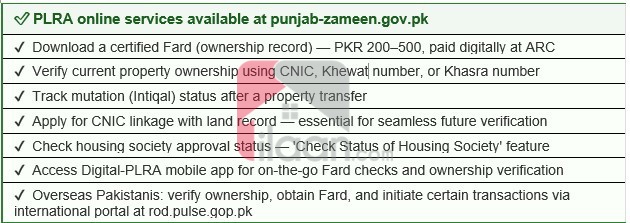
An important 2026 update: PLRA has introduced mandatory CNIC linking for all Fard Baraye Bay the Fard document used in sale transactions. The buyer's CNIC and name must now appear on the Fard at the point of transfer, creating a digital trail that makes it significantly harder to fraudulently sell property in someone else's name.
What Still Requires Physical Presence in Punjab
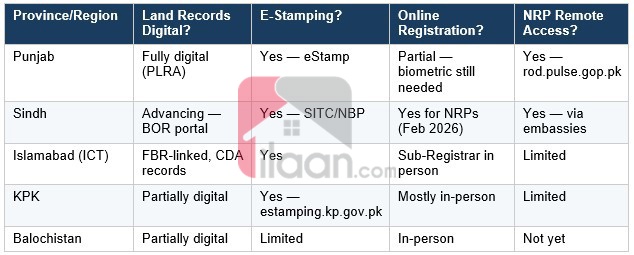
Despite the digital advances, not everything in Punjab's property registration process can be completed online. As of 2026, the following still require at least one in-person visit:
• Final biometric verification at an ARC both buyer and seller must verify identity via NADRA-linked fingerprint scanner
• Full mutation (Intiqal) attestation digital initiation is possible, but attestation requires presence at ARC with both parties and witnesses
• Property registration (Baya Nama) at Sub-Registrar final deed execution still requires both parties to appear before the Sub-Registrar in person (with a key exception for overseas Pakistanis, discussed below)
Sindh E-Registration: A Major 2026 Breakthrough
On February 11, 2026, the Sindh Cabinet chaired by Chief Minister Syed Murad Ali Shah formally approved the Sindh Registration (Amendment) Bill, 2025, launching a digital property registration system specifically designed for overseas Pakistanis.
This is one of the most significant developments in Pakistan's property documentation history. Here is what it means in practice:
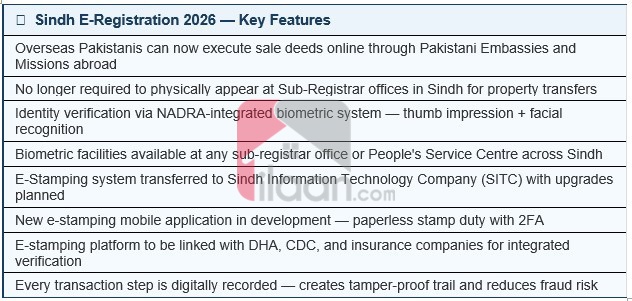
The Sindh e-registration system uses the same NADRA infrastructure that powers CNIC verification meaning the identity check at a Pakistani Embassy in Dubai, London, or Toronto is as reliable as one conducted at a Sub-Registrar office in Karachi.
KPK and Other Provinces: Where Things Stand in 2026
KPK has launched its own e-Stamping portal at estamping.kp.gov.pk allowing digital calculation and payment of stamp duty for property transactions in Khyber Pakhtunkhwa. The system is linked with FBR IRIS records, requiring that seller and buyer names match their FBR registration exactly.
Balochistan and parts of rural Sindh remain the least digitised in terms of property documentation, though urban centres are increasingly connected to digital verification systems through the broader FBR network.
How to Verify Property Ownership Online in Pakistan- Step by Step
Before buying any property in Pakistan, use these official digital platforms to verify the ownership claim:
For Punjab Properties
1. Visit punjab-zameen.gov.pk
2. Select 'Fard' or 'Verify Ownership'
3. Enter District → Tehsil → Mouza (exact village/area name)
4. Enter Khewat or Khasra number, or search via CNIC
5. Download the Fard confirms current registered owner, co-owners, and any encumbrances
Fee: PKR 200–500 paid digitally at PLRA service centres. No unofficial charges are permitted under the digital system.
For Sindh Properties
6. Access the Board of Revenue Sindh portal or Sindh e-stamping system
7. Verify DC rate valuation and check registered encumbrances
8. For registered deeds: contact the relevant Sub-Registrar's office directly or use the BOR Sindh online system
For All Properties FBR Cross-Check
9. Visit iris.fbr.gov.pk
10. Verify the seller's ATL (Active Taxpayer List) status this determines their 236C withholding tax rate
11. Confirm FBR valuation of the property this forms the base for tax calculations at registration

Overseas Pakistanis: How to Manage Property Remotely in 2026
The combination of PLRA's international portal, Sindh's embassy-based e-registration, and FBR's digital tax systems means that overseas Pakistanis now have more remote access to Pakistan's property market than ever before.
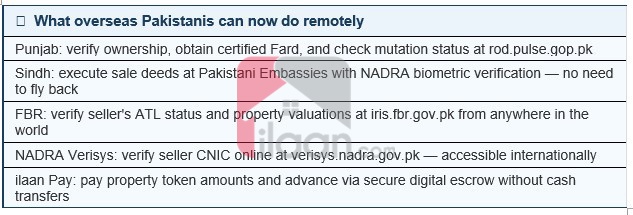
The Sindh e-registration model (February 2026) is the most significant breakthrough specifically for NRPs it is the first time in Pakistan's history that a property sale deed can be legally executed and registered without the buyer or seller being physically present on Pakistani soil.
Punjab is expected to follow with a similar NRP-specific remote registration framework, though as of mid-2026 biometric verification at an ARC remains required for final deed registration in Punjab.
How Digital Documentation Is Reducing Property Fraud in Pakistan
The shift to digital land records has a direct, measurable impact on the types of property fraud that have historically plagued Pakistan's real estate market:
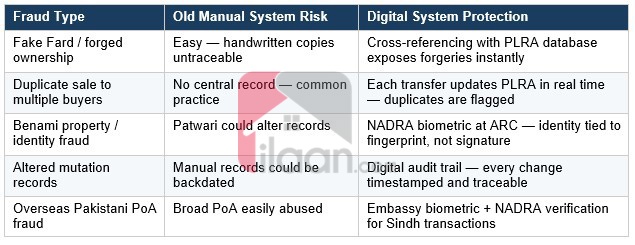
Fraud has not been eliminated determined fraudsters still find gaps, and digitisation is uneven across provinces. But the combination of PLRA's digital records, NADRA biometric verification, and FBR's linked tax system has created multiple cross-checking layers that simply did not exist five years ago.
For buyers, this means the tools to verify a property's legal status have never been more accessible. Use them. Read our full guide to avoiding property scams in Pakistan for the complete fraud-prevention checklist.
Digital Tools to Use Before Every Property Transaction
• PLRA Portal — punjab-zameen.gov.pk Punjab ownership verification, Fard download, mutation tracking
• FBR IRIS — iris.fbr.gov.pk seller ATL status, property FBR valuation, tax compliance check
• NADRA Verisys — verisys.nadra.gov.pk CNIC verification of seller identity
• KPK E-Stamping — estamping.kp.gov.pk stamp duty calculation and payment for KPK properties
• ilaan.com Property Tax Calculator calculate total transaction costs (236K, 236C, stamp duty, CGT) for your specific property under Budget 2026-27 rates
FAQ: Online Property Registration in Pakistan 2026
Can I register property fully online in Pakistan in 2026?
Not completely yet. In Punjab, you can verify ownership and get Fard online, but final registration (Baya Nama execution) still requires NADRA biometric verification at an Arazi Record Centre. In Sindh, overseas Pakistanis can now execute sale deeds through Pakistani Embassies without visiting Pakistan. For residents of Pakistan, physical presence at the Sub-Registrar's office is still required for final deed registration in most provinces.
How do I get a Fard online in Punjab?
Visit punjab-zameen.gov.pk and navigate to the Fard service. Select your District, Tehsil, and Mouza, then search by Khewat/Khasra number or CNIC. Pay the nominal fee (PKR 200–500) digitally at an ARC or via the portal. Your certified Fard showing current ownership, co-owners, and encumbrances — is available for download.
Can overseas Pakistanis buy property without visiting Pakistan in 2026?
Yes in Sindh. Following the February 2026 Sindh Registration Amendment, overseas Pakistanis can execute sale deeds at Pakistani Embassies and Missions abroad, with NADRA-integrated biometric verification (fingerprint + facial recognition). The completed registration is transmitted electronically to the Sub-Registrar in Sindh. In Punjab, remote access is still limited to verification and Fard services physical presence is still needed for final registration.
Is a digitally obtained Fard legally valid in Pakistan?
Yes. A Fard obtained through the PLRA portal (punjab-zameen.gov.pk) carries the same legal validity as a Fard issued at an ARC in person. Both are official government-issued documents reflecting the current state of land records in Punjab. The same applies to e-stamped documents generated through official provincial portals in Sindh and KPK.
What is e-stamping and how does it work in Pakistan?
E-stamping replaces traditional paper stamp papers with a digital equivalent. Instead of buying a physical stamp paper from a vendor, you pay stamp duty online through the relevant provincial portal and receive an e-stamp certificate with a unique QR code and verification number. In Punjab, this is managed through the Punjab e-Stamp system. In Sindh, it is handled by the Sindh Information Technology Company (SITC) in collaboration with National Bank of Pakistan. In KPK, the portal is estamping.kp.gov.pk. E-stamp certificates are legally equivalent to paper stamps and are linked to CNIC records for verification.
How does digital documentation help buyers avoid fraud?
Digital land records allow buyers to independently verify ownership at PLRA before meeting any seller cross-checking the CNIC on the Fard with NADRA Verisys eliminates identity fraud. NADRA biometric verification at registration prevents anyone else from signing on the seller's behalf. FBR IRIS cross-checks ensure the property is in the seller's tax record. Each layer closes a gap that fraudsters previously exploited. For the complete fraud-prevention process, read our property scam safety guide.
Final Word
Pakistan's property registration infrastructure is in the middle of a genuine digital transformation not complete, not uniform across provinces, but meaningfully further along in 2026 than at any point before. Punjab's PLRA has built one of the most comprehensive digital land record systems in South Asia. Sindh's February 2026 e-registration launch has opened the door for overseas Pakistanis to participate in the Karachi property market without an air ticket. FBR's IRIS integration has made tax compliance in property transactions more transparent and harder to manipulate.
For buyers and sellers, the message is clear: use the digital tools that now exist. Verify ownership on PLRA before you pay a token. Check the seller's CNIC on NADRA Verisys. Confirm ATL status on FBR IRIS. These checks take minutes and can save you from disputes that last decades.
Start your verified property search on ilaan.com where every owner's CNIC is confirmed before their listing is published, and where SafePay escrow protects your advance from the moment you decide to move forward.