How to Get a Green Certificate for Your Property in Pakistan: Complete 2026 Guide
Punjab's new Green Property Certificate (GPC) replaces the Fard from July 2026. Learn what it is, how to get it, the fee, the step-by-step process, and what it means for buyers, sellers, and overseas Pakistanis.
By ilaan Editorial Desk
Updated 16 Jul 2026
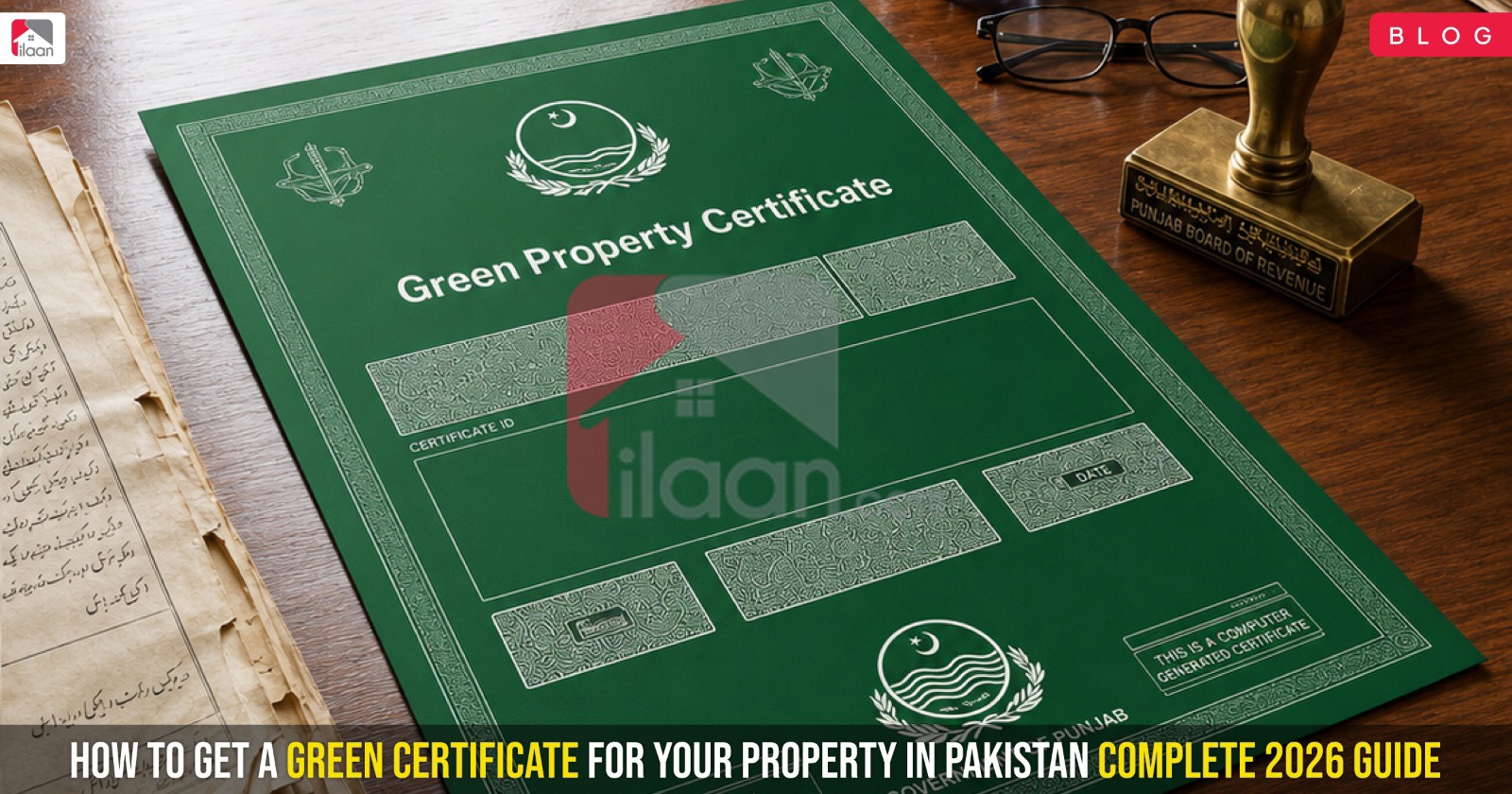
Punjab has just replaced a 486-year-old property documentation system with a single digital document: the Green Property Certificate (GPC).
If you own property in Punjab or are planning to buy, sell, or transfer property anywhere in the province, this change affects you directly. From July 1, 2026, no land or property transaction in any of Punjab's 41 districts can be completed without a Green Property Certificate. The traditional Fard, which has served as Pakistan's proof of property ownership since the era of Sher Shah Suri in the 16th century, is being phased out entirely.
This guide covers everything you need to know: what the Green Property Certificate is, why it was introduced, how to apply, what it costs, and what it means for buyers, sellers, and overseas Pakistanis.
Important: As of July 1, 2026, the Green Property Certificate is mandatory for ALL property transactions in Punjab's 41 districts. This was confirmed by PLRA Director Faisal Ahmed on Radio Pakistan on June 27, 2026. Always verify the latest implementation status with your nearest Arazi Record Centre before completing any transaction. Browse verified properties on ilaan.com, all listings from CNIC-verified owners.
What Is the Green Property Certificate?
The Green Property Certificate (GPC) is a digitally verified property ownership document introduced by the Punjab Land Records Authority (PLRA) under the Punjab Urban Land Systems Enhancement (PULSE) Project, in collaboration with the Board of Revenue, Punjab.
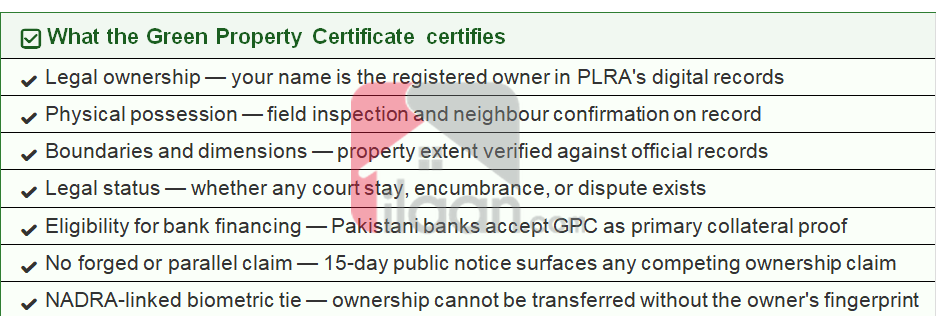
It is designed to do something that the old Fard never could , confirm not just ownership, but also possession, legal status, and eligibility for bank financing, all in a single, QR-coded digital document.
PLRA spokesperson Ali Raza Buttar confirmed to Wealth Pakistan: "No land transaction will be possible in the province without a Green Property Certificate in any of Punjab's 41 districts from the beginning of fiscal year 2026-27."
Why Was the Fard Replaced? The Problem With the Old System
The Fard system dates to the 16th century — land revenue practices originally introduced under Sher Shah Suri and formalised during British colonial rule. For centuries, it remained the cornerstone of property ownership proof in Pakistan.
But it had three fundamental weaknesses that made it increasingly inadequate for Pakistan's modern real estate market:
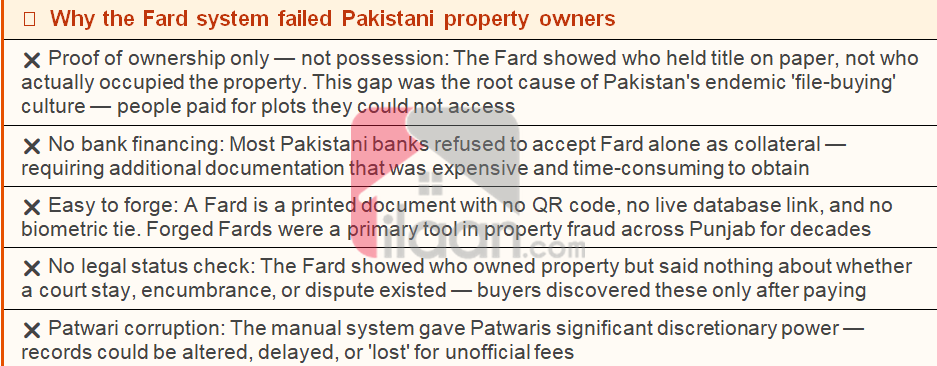
The GPC addresses every one of these failures. PLRA Director Faisal Ahmed described it as "a landmark initiative aimed at ensuring greater transparency, security, and efficiency in land administration and property transactions across Punjab."
Rollout Timeline: When Does It Apply to Your Area?
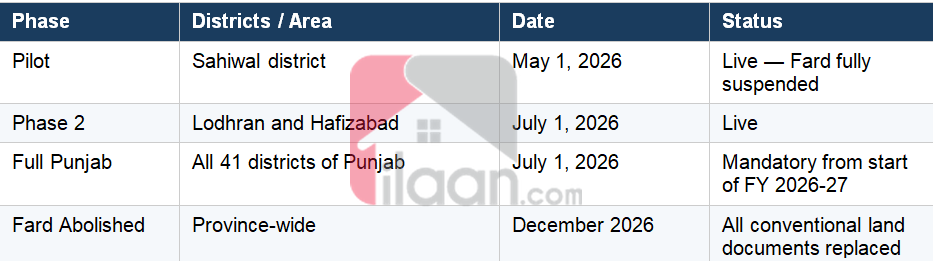
The Board of Revenue's April 28, 2026 letter to Sahiwal formally stated that "the Green Property Certificate and property reports issued under the Punjab PLRA (management of land records) Regulations 2025 shall constitute the sole valid documents for land record transactions" within pilot jurisdictions.
How to Apply for a Green Property Certificate: Step by Step
The application process must be initiated at your nearest Arazi Record Centre (ARC). As of July 2026, online application is not yet available; all processing begins in person at the ARC.
1. Visit your nearest Arazi Record Centre (ARC)
Go to the ARC in the Tehsil or District where your property is registered. Over 200 ARCs are operational across Punjab — find your nearest one through the PLRA website at punjab-zameen.gov.pk.
2. Obtain a token and submit property details
At the reception, collect a processing token. Provide complete property details including Khasra number, Khewat number, and Mouza (area name). All information is entered into the PLRA digital system.
3. Pay the official fee: PKR 950
The Green Property Certificate fee is PKR 950 — a concessional rate introduced for the initial rollout. Payment must be made through official channels at the ARC. No payment should be made outside the official system or to any individual.
4. Identity verification via CNIC and biometric
Your identity is confirmed through your original CNIC and NADRA-linked biometric verification (fingerprint scan) at the ARC. This ties the ownership record permanently to your biometric identity — the single most important fraud-prevention feature of the new system.
5. Documents required — have these ready
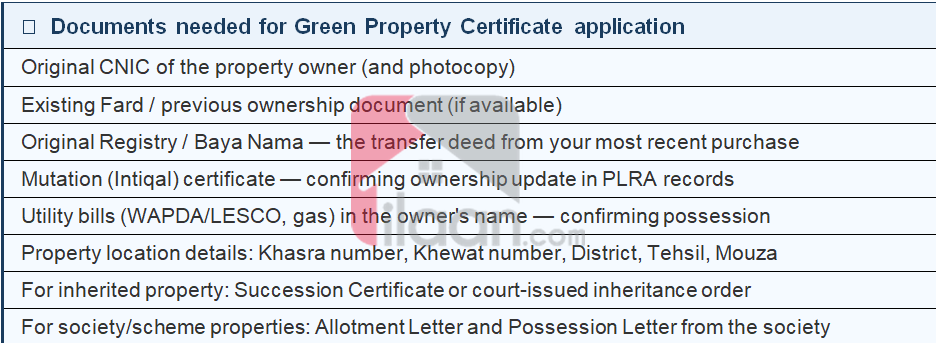
1. Ownership history and field inspection
PLRA officials review the full ownership history of your property in the digital system. A field inspection is then conducted — a revenue staff member or Grade-17 officer visits the property to physically confirm boundaries and possession.
2. Neighbour confirmation (Tatimma)
Two registered neighbouring property owners confirm your ownership and possession — a process called Tatimma. This is a key step that the old Fard system lacked entirely, and one reason the GPC provides stronger possession proof.
3. 15-day public notice period
A public notice is issued for 15 days, during which any third party with a disputed claim on the property can formally object. If no valid objections are raised within this window, the GPC is approved.
4. Certificate issued and available for collection
After all verifications are completed and the objection window closes, your Green Property Certificate is issued and available for collection from the ARC. The certificate includes a unique QR code that links directly to your property record in the live PLRA database, allowing instant verification by any buyer, bank, or court.
After you receive your GPC: Use ilaan.com's Property Tax Calculator to understand your updated tax obligations — including how the GPC affects your property's FBR valuation and transaction costs under Budget 2026-27 rates.
What Does the Green Property Certificate Confirm?
Unlike the old Fard, the GPC is a comprehensive legal and physical status document. Here is exactly what it confirms:
Overseas Pakistanis: How to Get a Green Property Certificate Without Visiting Pakistan
One of the most common questions from overseas Pakistanis (NRPs) is whether they need to physically return to Pakistan to obtain a GPC. The answer: not necessarily.
PLRA has confirmed that NRPs can appoint a trusted representative in Pakistan through a legally executed Special Power of Attorney (SPA). The appointed representative can complete all ARC procedures — document submission, fee payment, biometric verification (using the PoA documentation), and certificate collection — on behalf of the overseas owner.
Steps for overseas Pakistanis to get a GPC remotely
Execute a Special Power of Attorney (SPA) — specific and time-limited — at the Pakistani Embassy or Consulate in your country of residence
The SPA must specifically authorise your representative to apply for the Green Property Certificate at PLRA
Your representative takes the notarised SPA, your CNIC copy, and all property documents to the nearest ARC
PLRA processes the application through the representative — biometric may use SPA documentation as authorisation
Verify ownership anytime at punjab-zameen.gov.pk using your CNIC — accessible from anywhere in the world
Once issued, GPC can be shared digitally with buyers, banks, or courts — no physical courier needed
Important: Use a Specific Power of Attorney — not a General PoA. A broad, unlimited PoA is a known fraud vehicle. Limit the SPA to one specific purpose (Green Property Certificate application) with a clear expiry date. For full guidance, see our Essential Property Documents Checklist.
What the GPC Means for Property Buyers and Sellers in Punjab
For Buyers
The Green Property Certificate fundamentally changes what a buyer can verify before paying. Previously, a buyer had to run multiple separate checks — Fard, Non-Encumbrance Certificate, court search, possession inquiry — across different offices. The GPC consolidates all of this.
• QR code on the GPC links directly to live PLRA database — scan and verify ownership in seconds
• No more separate Non-Encumbrance Certificate — legal status is embedded in the GPC
• Possession confirmation built in — reduces the risk of buying a property someone else occupies
• Faster bank loan processing — banks accept GPC, reducing loan approval timelines
• 15-day public notice during issuance means active disputes are surfaced before the certificate is issued
For Sellers
No property transaction in Punjab can be completed without a GPC from July 2026. If you are planning to sell, this means:
• Get your GPC before listing your property — do not wait until a buyer is found, as the 15-day notice period adds time
• Properties with clear, undisputed title will sail through the GPC process — use this as a selling advantage
• The GPC becomes your primary listing document — list on ilaan.com/property-for-sale with GPC details to attract serious, informed buyers
• Combined with Budget 2026-27's halved transaction taxes, 2026 may be an optimal time to sell in Punjab
Does the GPC Apply to Properties in DHA, Bahria Town & Private Societies?
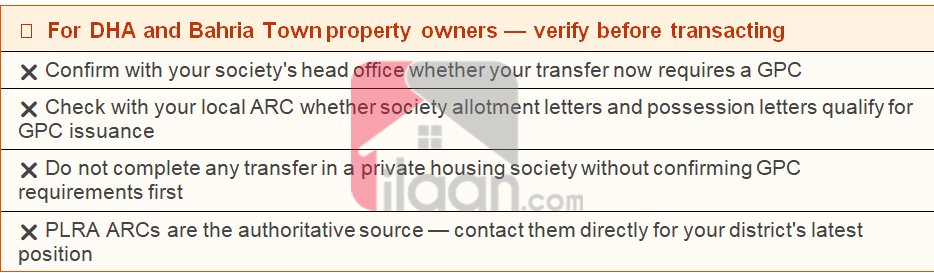
This is one of the most frequently asked questions. The PLRA's official position is that the GPC applies to all property transactions in Punjab — including properties in private housing societies.
However, as noted by Sardar Tahir Mehmood (Real Estate Associations President), the government has been urged to ensure "land and property transactions in private housing societies are also effectively brought under the new system." The practical implementation for DHA and Bahria Town properties, which have their own internal transfer and documentation systems, is still evolving as of mid-2026.
FAQ: Green Property Certificate Pakistan 2026
Is the Green Property Certificate mandatory for all property transactions in Punjab?
Yes. PLRA Director Faisal Ahmed confirmed on June 27, 2026 that effective July 1, 2026, all types of land and property transactions in all 41 districts of Punjab require a Green Property Certificate. The traditional Fard has been suspended in pilot districts since May 1, 2026 and will be fully abolished province-wide by December 2026.
What is the fee for the Green Property Certificate?
The official fee is PKR 950, a concessional rate for the initial rollout phase. This must be paid through official channels at the Arazi Record Centre. There are no authorised unofficial charges. If anyone demands payment beyond the official PKR 950 fee, do not pay and report the matter to the PLRA helpline.
How long does it take to get a Green Property Certificate?
The process involves multiple steps including field inspection, neighbour confirmation, and a mandatory 15-day public notice period. Total processing time typically ranges from 3 to 6 weeks from application to certificate issuance, depending on district workload and whether any objections are raised during the notice period.
Is the Fard still valid after July 2026?
No — in districts where the GPC has been made mandatory, the Fard is no longer a valid transaction document. In Sahiwal, Fard issuance has been fully suspended since May 1, 2026. The Board of Revenue's April 28 letter explicitly stated that the GPC and property reports under PLRA Regulations 2025 "shall constitute the sole valid documents for land record transactions." Full province-wide abolition of conventional land documents including Fard is expected by December 2026.
Can I sell my property without a Green Property Certificate in Punjab?
No. From July 1, 2026, no sale, purchase, or transfer can be completed in any of Punjab's 41 districts without a Green Property Certificate. If you are planning to sell, apply for your GPC before listing your property — factoring in the 3–6 week processing timeline.
Does the GPC replace the Non-Encumbrance Certificate?
The GPC integrates the legal status check that previously required a separate Non-Encumbrance Certificate — confirming whether any mortgage, lien, or court stay exists on the property. However, until the system is fully mature and accepted by all courts and financial institutions, it is advisable to still obtain an NEC for high-value transactions. Consult a property lawyer for the latest position in your district.
What happens to properties that already have a valid Fard?
Existing property owners with valid Fard documents will need to convert their records to a Green Property Certificate before any future sale, transfer, or bank financing. The Fard does not expire retroactively — it simply cannot be used to complete transactions from the mandatory date in your district. Apply at your nearest ARC proactively rather than waiting until you need to transact.
Final Word
The Green Property Certificate is the most significant reform to Pakistan's land ownership system in decades — perhaps ever. Replacing a 486-year-old Patwari-based Fard system with a QR-coded, biometrically verified, possession-confirming digital certificate is not just an administrative upgrade. It is a fundamental change in what property ownership means in Punjab.
For buyers, it provides unprecedented verification ability. For sellers, it is now a legal prerequisite. For overseas Pakistanis, it provides a path to verify and transact remotely. For the entire market, it closes the gaps that property fraud has exploited for generations.
If you own property in Punjab, start your GPC application now — do not wait until a transaction forces urgency. And if you are looking to buy verified property in Punjab, search on ilaan.com where every listing comes from a CNIC-verified owner, and the SafePay escrow protects your advance from day one.