
How to Declare Property in FBR Return 2026: Complete Guide
Learn how to declare a house, plot, commercial property or rental income in your FBR return and wealth statement for Tax Year 2026 in Pakistan.
By ilaan Editorial Desk
Updated 19 Sept 2026
Last updated: 19 September 2026
Property owners filing an FBR income tax return for Tax Year 2026 must correctly report their property assets, associated liabilities, applicable rental income and the movement of funds in their wealth reconciliation statement.
Tax Year 2026 normally covers the period from 1 July 2025 to 30 June 2026. Under the current Income Tax Ordinance, the statutory filing date for non-company taxpayers is 30 September 2026, unless the Federal Board of Revenue officially announces an extension.
Quick answer: To declare property in your FBR return for Tax Year 2026, report the property under the relevant asset category in your wealth statement, enter any outstanding home finance separately as a liability, declare rental income where applicable and reconcile the source of funds used to purchase the property.
FBR Tax Year 2026 at a Glance
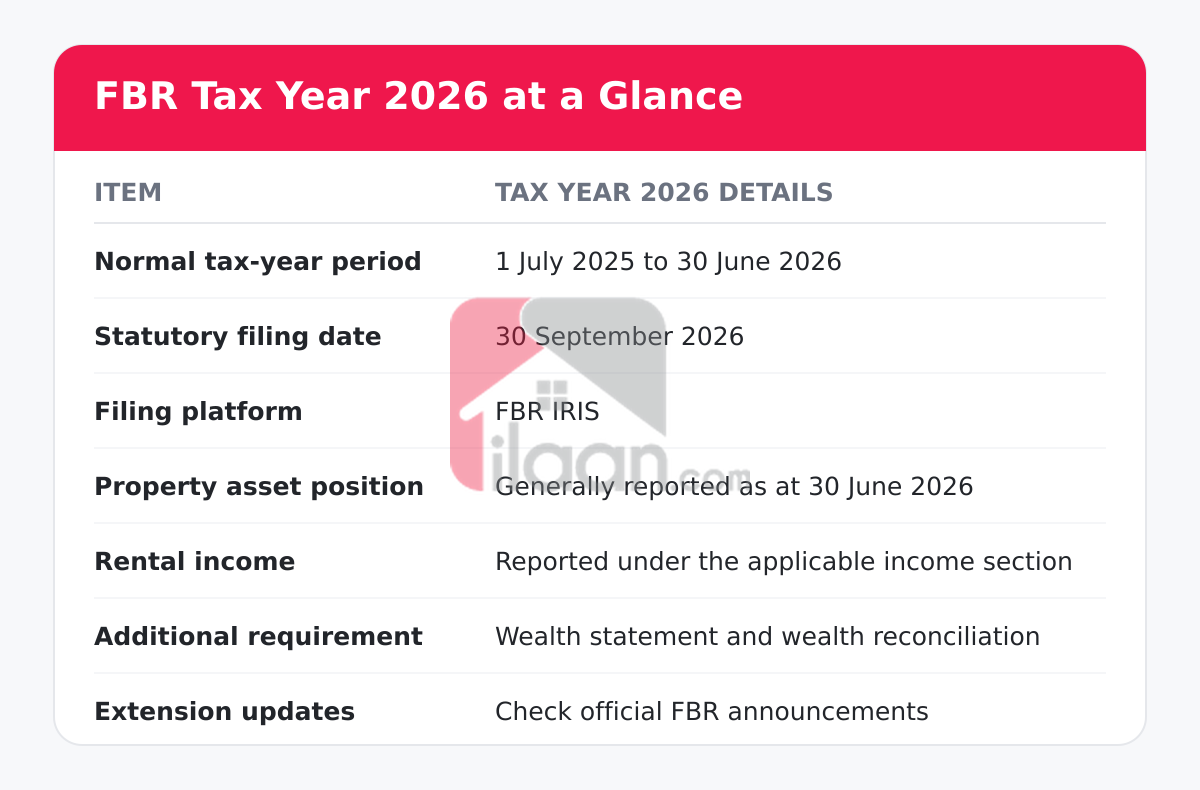
FBR Tax Year 2026 key dates and property declaration requirements.
The tax-year period and filing date are based on Sections 74 and 118 of the Income Tax Ordinance, 2001, amended up to 30 June 2026.
Is Property Declared in the Income Tax Return or Wealth Statement?
A property may affect more than one section of an FBR filing. The correct section depends on whether the property is self-occupied, rented, purchased, sold or financed.
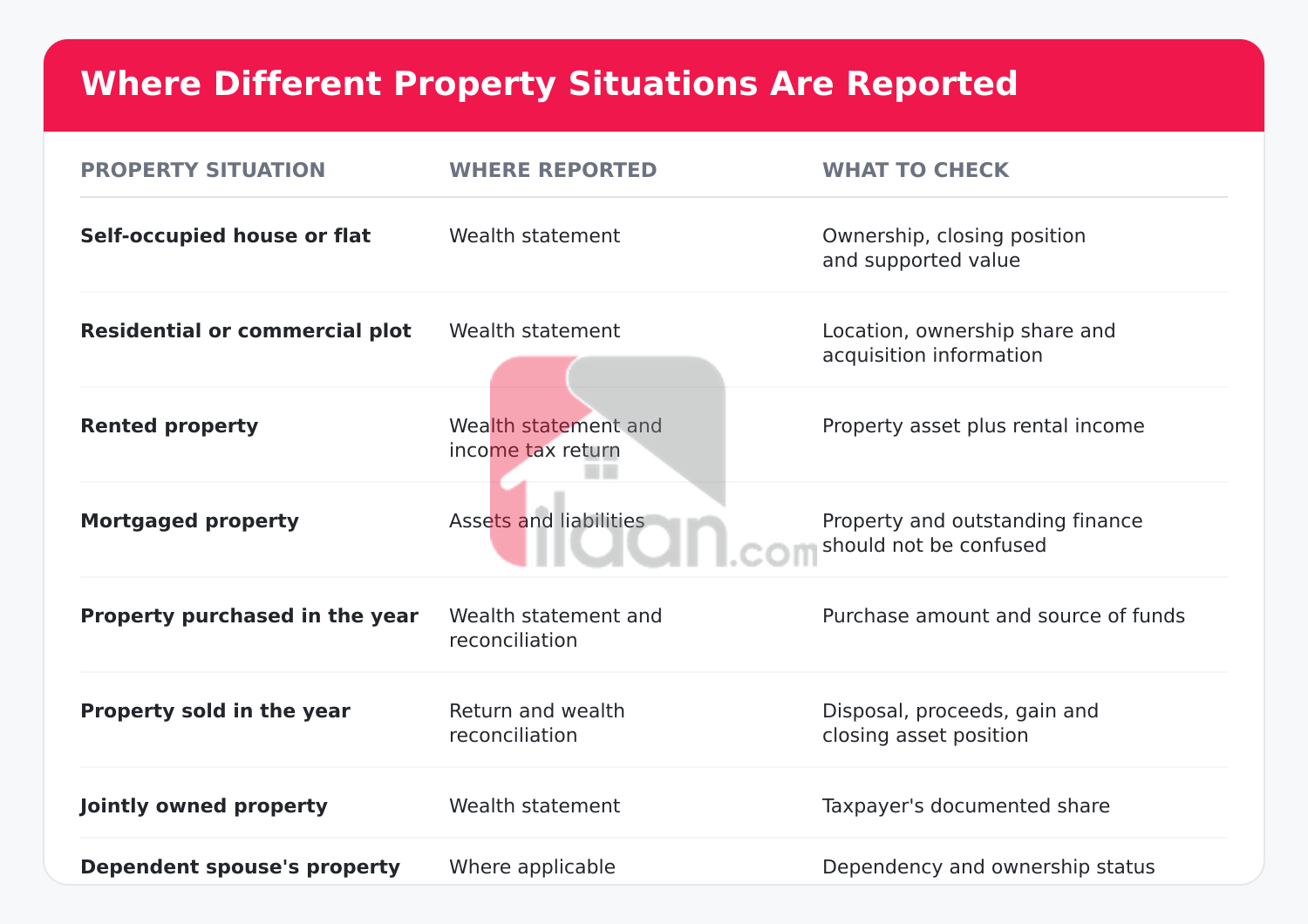
How common property situations are generally reported in an FBR filing.
The property itself normally appears in the wealth statement, while income earned from renting the property is dealt with under Income from Property. A purchase or sale must also be reflected correctly in the wealth reconciliation.
Who Is Required to File an FBR Return?
Owning property does not automatically create the same filing requirement for every person. Section 114 of the Income Tax Ordinance contains several filing triggers, including:
Taxable income above the applicable non-taxable limit
Previous tax assessments or carried-forward losses
Certain property ownership tests based on property type, size and location
Holding a National Tax Number
Business income and other specified circumstances
Some property-related triggers apply to land or flats within municipal limits, cantonments, Islamabad Capital Territory and designated rating areas. Exceptions may also apply to certain individuals.
A property owner should therefore not assume that no return is required simply because the property is self-occupied or produces no rental income.
Under Section 116, a resident individual filing an income tax return must also furnish a wealth statement and wealth reconciliation statement for that tax year.
Documents to Collect Before Filing
Keep the following records ready before opening your Tax Year 2026 return:
CNIC and NTN details
Previous year's income tax return and wealth statement
Sale deed, allotment letter or transfer document
Property address, plot number, block and society details
Date of purchase, allotment or transfer
Documented purchase or acquisition amount
Bank statements showing the payment trail
Home finance or mortgage statement
Installment payment schedule, where applicable
Rental agreement and rental receipts
Withholding tax certificates or challans
Property sale agreement, if sold during the year
Gift deed, inheritance documents or succession certificate, where applicable
Records of provincial property tax payments
Keeping these documents together makes it easier to explain the property's ownership, value and source of funds if clarification is later required.
How to Declare Property in FBR Return 2026
Step 1: Confirm the Correct Tax Year
For most individual taxpayers, Tax Year 2026 covers income, assets, liabilities and transactions occurring from 1 July 2025 to 30 June 2026.
A property owned on 30 June 2026 will generally form part of the closing asset position for Tax Year 2026. If a property was purchased after 30 June 2026, it would not normally be a closing property asset for Tax Year 2026. However, an advance or installment paid before the year-end may still require appropriate disclosure.
Step 2: Sign In to FBR IRIS
Access the official FBR IRIS portal and sign in using your registered credentials.
Select the income tax return and wealth statement for Tax Year 2026. Always confirm the tax year before entering information because opening the wrong period can create inconsistencies with previous filings.
FBR also provides official income tax return and wealth statement tutorials.
Step 3: Complete Your Income Information
Enter the applicable income from salary, business, property, capital gains or other sources.
If the property was rented during the tax year, the rental income should be addressed under the relevant Income from Property section. Showing the property as an asset does not automatically report the rent earned from it.
Step 4: Add the Property to Your Wealth Statement
Navigate to the personal assets and liabilities section of the wealth statement and select the appropriate property or immovable-asset category.
The exact field names may change as FBR updates IRIS, but the requested information may include:
Property description and type
Complete location or address
Ownership share
Acquisition or transfer date
Amount required by the current form
Other property-identification details
Use a clear description such as:
10 Marla residential house, Block A, DHA Phase 6, Lahore — 100% ownership
Avoid descriptions such as “house” or “plot” without a location or ownership detail.
Step 5: Enter the Property Amount Carefully
Property owners commonly confuse three different figures:
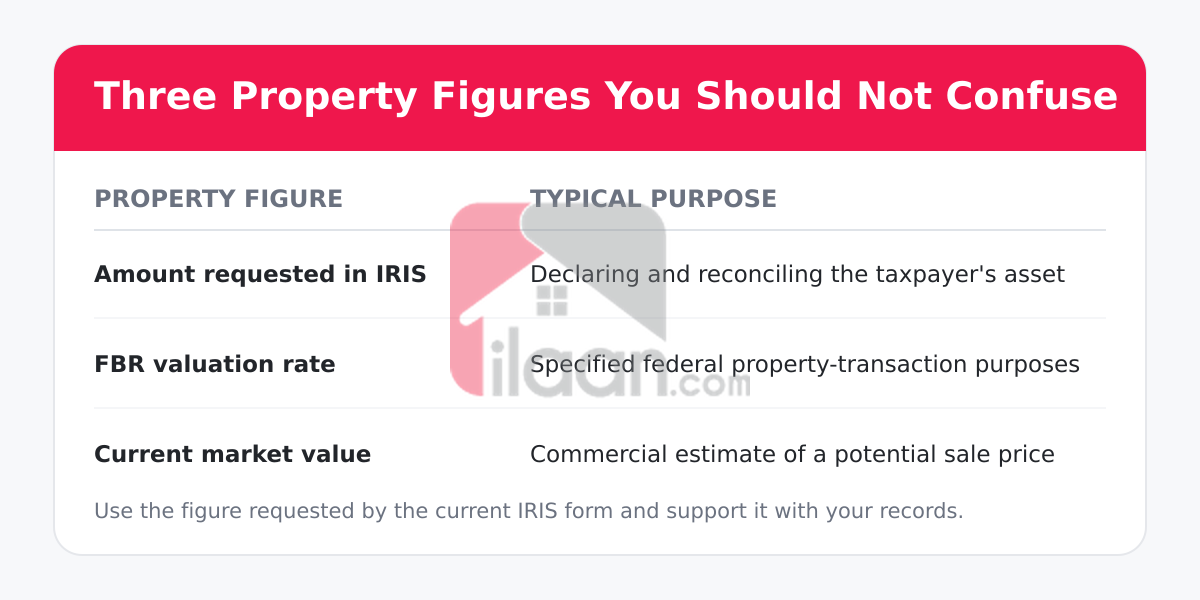
Three property figures taxpayers should not confuse.
These figures are not automatically interchangeable. Enter the amount requested by the current Tax Year 2026 form and ensure it is supported by the ownership and acquisition documents.
FBR publishes separate valuation information for immovable properties. Where the appropriate amount is uncertain—particularly for inherited, gifted, jointly owned or installment-based property—consult a qualified tax practitioner.
Step 6: Declare Outstanding Property Finance Separately
If the property was purchased through home finance, a mortgage or another documented loan, the property and the outstanding liability should be reviewed separately.
The house is entered under the appropriate asset category.
The outstanding documented home finance is entered under liabilities.
Payments made during the year affect the wealth reconciliation and closing liability.
Do not simply reduce the property asset by the loan amount unless the current IRIS form and applicable tax treatment specifically require it.
Step 7: Complete the Wealth Reconciliation
The wealth reconciliation explains how your closing wealth changed during the tax year.
Opening wealth + declared income and supported inflows − personal expenses and other outflows = closing wealth
If you purchased a property during Tax Year 2026, the source of the payment must be visible in the reconciliation. Possible documented sources may include:
Salary or business income
Existing bank savings
Sale proceeds from another asset
A documented loan
Inheritance or a properly documented gift
Foreign remittance
Joint contribution from another documented owner
A property purchase without a supported source of funds can create a reconciliation difference even when the asset itself has been entered correctly.
Step 8: Review Property Taxes and Transaction Records
Check whether advance income tax or withholding tax was collected when the property was purchased or sold. Match available challans and certificates with the applicable entries in the return.
Annual provincial property tax is separate from the federal income tax return. Punjab property owners can also read the ilaan guide to the Punjab Property Tax Rebate 2026 or use the ilaan Property Tax Calculator for an initial estimate.
Official government records and challans remain authoritative.
Step 9: Run a Final Consistency Check
Before submitting, compare:
Current property assets with the previous wealth statement
Purchase and sale dates with legal documents
Bank withdrawals with property payments
Rental income with the rental agreement and payment records
Outstanding finance with the lender's statement
Withholding taxes with certificates or challans
Closing bank balances with bank statements
Total closing wealth with the wealth reconciliation
Once filed, download and retain the return, wealth statement, submission acknowledgement and payment records.
How to Declare Rental Income from Property
Section 15 of the Income Tax Ordinance generally treats rent received or receivable by the owner of land or a building as Income from Property, unless a specific exemption or different treatment applies.
Property owners should maintain records of monthly rent, the rental period, tenant and property details, bank transfers or receipts, withholding tax deducted where applicable, eligible expenses and any security deposit or other payment connected with the tenancy.
The law can apply fair-market-rent rules where declared rent is lower than fair market rent, subject to relevant exceptions. Amounts charged for services, utilities or amenities may also require different treatment.
Because deductions and classifications depend on the property, taxpayer and current law, rental-property owners should obtain professional advice before claiming expenses.
How to Report a Property Purchased During Tax Year 2026
If you purchased a property between 1 July 2025 and 30 June 2026 and still owned it at the end of the tax year:
Add it to the relevant property category in the wealth statement.
Enter the documented information requested by IRIS.
Show outstanding finance separately, where applicable.
Reconcile the payment with its documented source.
Review any advance tax collected at purchase.
Retain the deed, payment evidence and bank trail.
For installment-based property, the appropriate disclosure can depend on the agreement, possession, ownership status and amounts paid. Avoid entering the full property price or only the installments without confirming the correct treatment.
How to Report a Property Sold During Tax Year 2026
If a property was sold before 30 June 2026, it would generally not remain in the closing property assets at year-end. However, the transaction does not disappear from the filing.
Review the sale consideration, capital gain where applicable, advance or withholding tax collected, closing bank or cash position, use of the sale proceeds, removal of the property from closing assets and the effect on wealth reconciliation.
If sale proceeds were used to buy another property, both transactions must connect logically through the reconciliation.
Jointly Owned Property
For a jointly owned house, plot or commercial property, declare the ownership share attributable to you according to the legal documents. A 50% owner should not ordinarily declare 100% of the jointly owned property as their personal asset.
Use the same ownership basis consistently across the wealth statement, rental income, purchase payments, sale proceeds and related liabilities.
Property Owned by a Spouse
Section 116 clarifies that a spouse's assets are included in a taxpayer's wealth statement where the spouse is dependent.
If the spouse is financially independent and files separately, avoid duplicating the same property without checking the applicable filing treatment. Ownership documents, dependency status, contribution toward purchase and previous declarations should all be considered.
Inherited or Gifted Property
Inherited or gifted property should not be treated as an ordinary cash purchase without supporting documentation.
Keep the relevant gift deed, donor information, succession certificate, inheritance documents, mutation or transfer record, ownership share and valuation support. The amount and manner of disclosure can depend on the facts, so professional tax advice is recommended.
Common Property Declaration Mistakes
Showing rental income but omitting the property asset
Showing the property asset but omitting rental income
Entering the full value of jointly owned property
Deducting a mortgage directly from the property asset
Using an unsupported market estimate
Failing to explain the source of purchase funds
Forgetting to remove a property sold before year-end
Ignoring sale proceeds in bank or cash balances
Entering a property under the wrong tax year
Copying the previous wealth statement without updating transactions
Omitting advance tax certificates
Filing with an unreconciled wealth difference
Final Property Filing Checklist
Confirm that the correct Tax Year 2026 form is open.
Review every property owned on 30 June 2026.
Use complete property descriptions and locations.
Match ownership shares with legal documents.
Enter rental income where applicable.
Review home finance under liabilities.
Reflect purchases and sales correctly.
Check available withholding tax records.
Match bank balances with supporting statements.
Resolve any unexplained wealth reconciliation difference.
Download the submitted return and acknowledgement.
Frequently Asked Questions
What is the deadline for filing an FBR return for Tax Year 2026?
The statutory filing date for non-company taxpayers is 30 September 2026. Taxpayers should monitor official FBR press releases for any subsequent extension or procedural update.
Does every property owner have to file an income tax return?
Not necessarily. Filing depends on income and other conditions under Section 114, including specified property size and location tests. Property owners should check their complete circumstances rather than relying only on whether the property generates rent.
Is a self-occupied house declared in the FBR return?
If you are filing a wealth statement and own the house at the end of the tax year, it generally needs to be considered as an asset even when it produces no rental income.
What value should I enter for my property?
Use the amount requested by the current IRIS form and supported by your acquisition and ownership records. Do not automatically substitute current market value or an FBR valuation rate for the figure required in the wealth statement.
Do I declare a mortgaged property?
The property and the outstanding documented finance should both be reviewed. The property is generally considered under assets, while outstanding finance is considered separately under liabilities.
What happens if I sold the property during the year?
Review the removal of the property from closing assets, the sale proceeds, capital gain, applicable withholding tax and the effect of the transaction on your wealth reconciliation.
Do I need to declare rental income received in cash?
The payment method does not, by itself, remove the reporting requirement. Keep the rental agreement and payment records and declare applicable rental income under the relevant section.
Can I revise a wealth statement after filing?
Section 116 provides a mechanism for revising a wealth statement subject to conditions, reasons and time limitations. Obtain professional advice before making a material revision.
List Your Property Directly on ilaan
Once your property documents and ownership details are organised, you can list your property free on ilaan and connect directly with serious buyers or tenants.
Direct Owner Deal • Verified Listings • 0% Commission
Important Disclaimer
This article provides general educational information and does not constitute legal, accounting or tax advice. FBR forms, procedures, deadlines and interpretations may change. Always verify the current position through FBR IRIS, official FBR announcements or a qualified tax practitioner before filing.