
Budget 2026-27 Property Tax Reforms: What Buyers & Sellers in Pakistan Need to Know
Pakistan's Budget 2026-27 cuts property withholding tax, abolishes Section 7E, and halves transaction costs. Here's exactly what changed for buyers, sellers, and overseas Pakistanis, with updated rate tables.
By ilaan Editorial Desk
Updated 15 Jul 2026

Budget 2026-27 Property Tax Reforms: What Buyers and Sellers Need to Know
Pakistan's Budget 2026-27, presented by Finance Minister Muhammad Aurangzeb on June 12, 2026, delivers some of the most significant real estate tax relief in recent years. Withholding taxes on property purchases and sales have been cut by roughly half for active tax filers, the controversial Section 7E deemed income tax has been abolished, and overseas Pakistanis have received targeted concessions to make formal property investment more attractive.
If you are planning to buy, sell, or invest in property in Pakistan this year, these changes directly affect your transaction costs, sometimes by millions of rupees on a single deal. This guide explains every major change in plain language, with updated rate tables and real-money examples.
Important: The rates in this guide reflect the Budget 2026-27 announcement of June 12, 2026. Final implementation depends on the Finance Act 2026 receiving presidential assent. Always verify current FBR-notified rates with a tax professional before completing any property transaction. Use ilaan.com's Property Tax Calculator for an updated estimate on your specific property.
Budget 2026-27: Key Property Tax Changes at a Glance
What changed for property in Budget 2026-27
✔ Section 236K (buyer withholding tax): cut from 2.5% to 1.25% for active filers
✔ Section 236C (seller withholding tax): cut from 5.5% to 2.75% for active filers
✔ Section 7E (deemed income tax on idle property): ABOLISHED entirely
✔ Capital Value Tax (CVT) on foreign assets: abolished, direct benefit for overseas Pakistanis
✔ Transaction costs on selling a PKR 20M property drop from PKR 1.1M to PKR 500,000 for filers
✔ IMF sign-off secured before announcement; changes have strong implementation backing
Section 236K Withholding Tax on Buyers: What Changed
Section 236K is the advance withholding tax collected from the buyer at the time of purchasing any immovable property in Pakistan. It is collected by the transferring authority (Sub-Registrar) at the time of Registry and is adjustable against the buyer's annual income tax return.
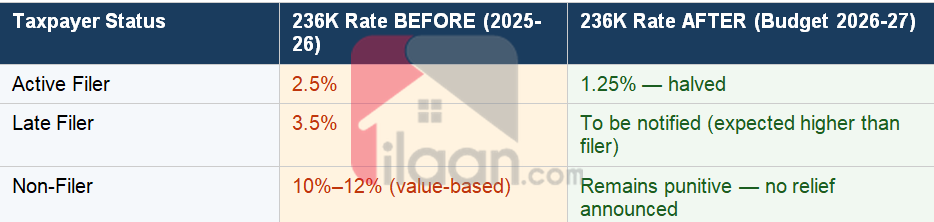
In practice: on a property worth PKR 1 Crore, an active filer's Section 236K tax drops from PKR 2,50,000 to PKR 1,25,000, a saving of PKR 1,25,000 on a single purchase transaction.
Non-filers continue to face significantly higher rates. This budget makes filer status more financially consequential than ever; the gap between active filer and non-filer transaction costs has widened.
Section 236C Withholding Tax on Sellers: What Changed
Section 236C is the advance withholding tax collected from the seller at the time of transferring any immovable property. Like 236K, it is adjustable, meaning it is offset against your final Capital Gains Tax (CGT) liability when you file your annual return.
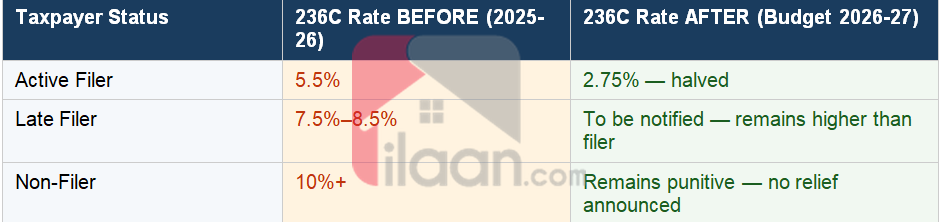
Real-money impact: on a PKR 2 Crore property sale, a filer's advance tax at the point of transfer drops from PKR 11,00,000 to PKR 5,50,000. As Finance Minister Aurangzeb's office noted, a filer selling a PKR 2 Crore property now retains PKR 6,00,000 more in liquidity compared to pre-budget rates.
Section 7E Deemed Income Tax: Abolished
This is arguably the most significant property tax change in Budget 2026-27 for long-term property owners. Section 7E was introduced in 2022 as a tax on deemed income from immovable property, essentially assuming that property owners earn 5% annual rent on their property value, and taxing that assumed income at 20%. The effective result: an annual tax of 1% of the FBR-assessed Fair Market Value of any property you own above PKR 25 million, whether you actually earn any rental income from it or not.
This tax was deeply unpopular, particularly among property owners who inherited land, retirees with property as their primary asset, and overseas Pakistanis who owned property in Pakistan without earning active rental income from it.
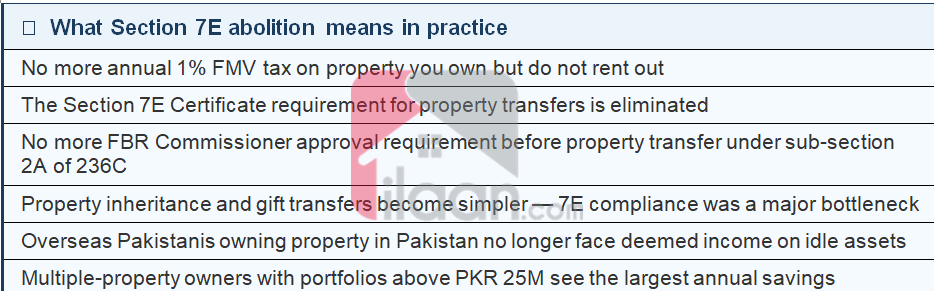
Example: A property owner with a portfolio of three properties at a combined FBR FMV of PKR 80 million was paying approximately PKR 8,00,000 per year in Section 7E tax. Under Budget 2026-27, that annual liability drops to zero.
Capital Gains Tax (CGT) on Property in 2026: What Stays the Same
Budget 2026-27 does not change the Capital Gains Tax (CGT) structure itself, which was reformed in 2024-25. The current CGT regime remains:
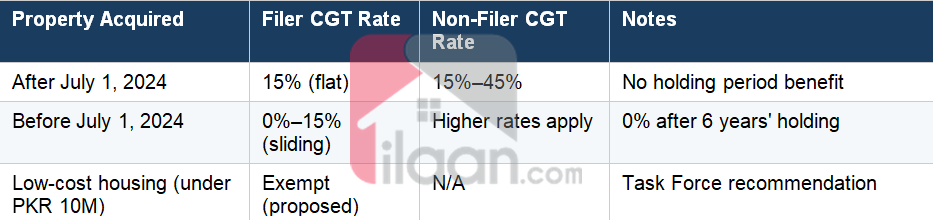
For properties acquired before July 2024, the old holding-period benefit still applies — your CGT reduces as you hold longer, reaching 0% after six years. For properties acquired after July 2024, the flat 15% CGT for filers applies regardless of holding period.
The 236C advance tax paid at the time of sale is fully adjustable against your CGT liability when you file your annual return, so you are not double-taxed. The net effect of halving 236C is improved cash flow at the point of sale, even though the eventual CGT liability remains unchanged.
Overseas Pakistani Property Investors: What the Budget Means for You
Budget 2026-27 includes Pakistan's most comprehensive package of incentives for overseas Pakistanis (NRPs) in several years:
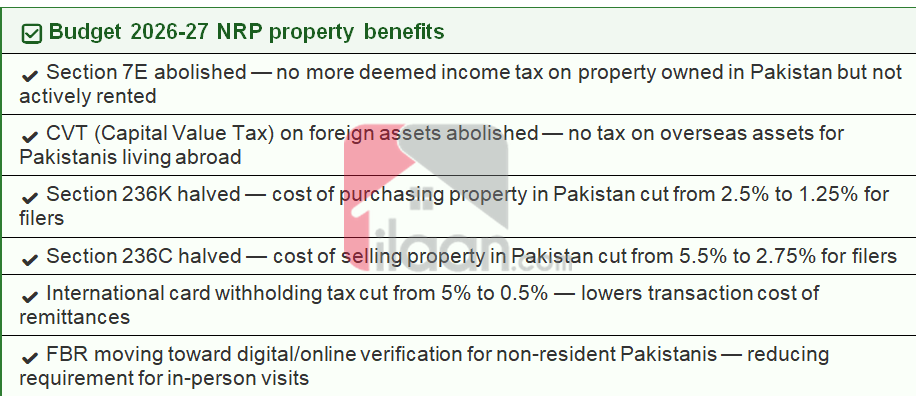
Analysts note that the combination of 7E abolition and halved WHT rates makes Pakistan property significantly more attractive for NRPs who had been deterred by the dual burden of annual deemed income tax plus high transaction costs. The IMF's agreement to these rate reductions signals sustained policy commitment rather than a one-year measure.
Filer vs Non-Filer: Why Your ATL Status Has Never Mattered More
Every tax change in Budget 2026-27 disproportionately benefits active tax filers, people on FBR's Active Taxpayer List (ATL). The gap between filer and non-filer transaction costs is now wider than at any point in Pakistan's tax history.
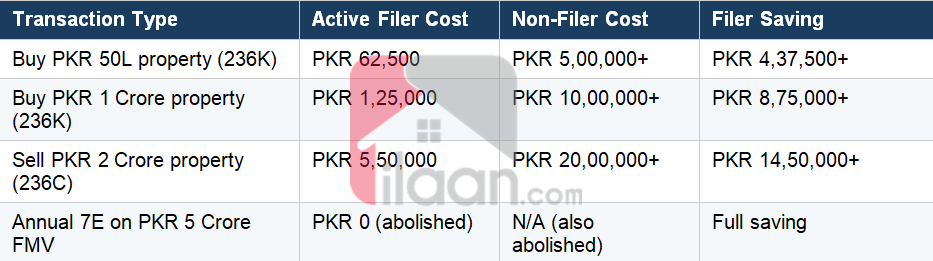
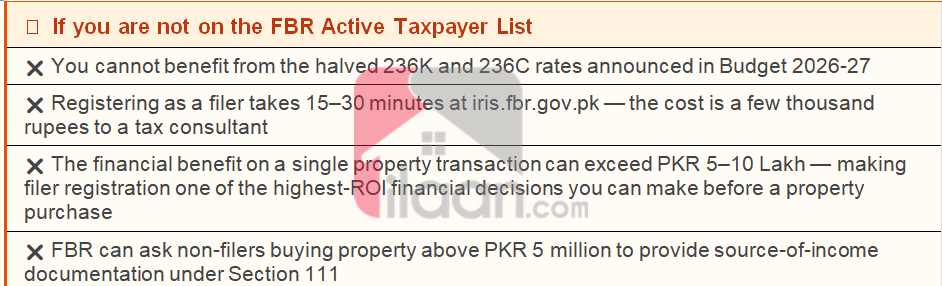
Complete Property Transaction Cost After Budget 2026-27 (Filer Buying in Punjab)
This table shows all costs a filer buyer faces in Punjab when purchasing property under Budget 2026-27 rates:
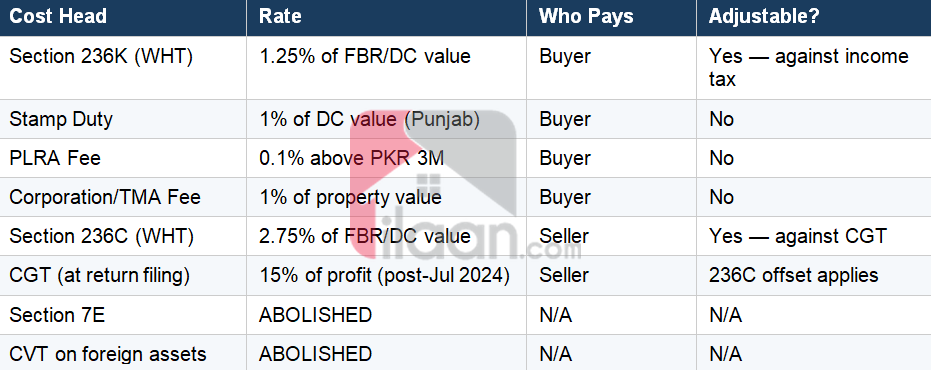
Use ilaan.com's Property Tax Calculator to plug in your specific property value, province, and filer status to get a personalised total transaction cost estimate — updated for Budget 2026-27 rates.
What Property Buyers and Sellers Should Do Now
If you are planning to buy property in 2026
• Confirm your ATL status at iris.fbr.gov.pk before making any purchase — your 236K rate depends on it
• Get a fresh Fard and Non-Encumbrance Certificate on the property — Section 7E abolition means some previously stuck transfers can now proceed cleanly
• Use the Property Tax Calculator to calculate your total transaction cost under the new rates before negotiating purchase price
• Browse verified, direct-owner listings on ilaan.com/property-for-sale — with lower transaction costs, your budget now goes further
If you are planning to sell property in 2026
• Check whether your property was acquired before or after July 1, 2024 — this determines which CGT regime applies
• File your income tax return before selling if you are not currently a filer — the 236C saving at 2.75% vs 5.5% can justify a tax consultant's fee many times over
• The abolition of Section 7E means you no longer need a Section 7E clearance certificate from FBR before transferring — verify this with your Sub-Registrar for the latest implementation position
• Consider whether reduced transaction costs make 2026-27 a strategically better time to sell than previous years — lower costs improve liquidity and buyer appetite simultaneously
FAQ: Budget 2026-27 Property Tax
Has Section 7E been completely abolished in Budget 2026-27?
Yes. Budget 2026-27, presented on June 12, 2026, proposes the complete abolition of Section 7E — the deemed income tax on immovable property. Once the Finance Act 2026 receives presidential assent, the annual 1% FMV tax on properties above PKR 25 million will no longer apply. The Section 7E Certificate requirement for property transfers is also removed.
What is the new Section 236K rate after Budget 2026-27?
For active tax filers, the Section 236K withholding tax on property purchases has been cut from 2.5% to 1.25% — a reduction of exactly half. Non-filers do not benefit from this cut and continue to face significantly higher rates. Your filer status on FBR's Active Taxpayer List (ATL) determines which rate applies to you.
What is the new Section 236C rate after Budget 2026-27?
For active tax filers, the Section 236C withholding tax on property sales has been cut from 5.5% to 2.75%. This is an adjustable advance tax — it is offset against your Capital Gains Tax liability when you file your annual income tax return. Non-filers remain subject to higher penal rates.
Does Budget 2026-27 change Capital Gains Tax on property?
No. CGT rates on property were not changed in Budget 2026-27. The current regime remains: flat 15% for filers on properties acquired after July 1, 2024, and the old sliding-scale structure (0%–15% based on holding period) for properties acquired before that date. The halving of 236C improves cash flow at point of transfer but does not change the eventual CGT liability.
Does Budget 2026-27 help overseas Pakistanis buying property?
Significantly. Overseas Pakistanis benefit from the abolition of Section 7E (no more deemed income on property owned in Pakistan), halved 236K rates on purchases, halved 236C rates on sales, and abolition of Capital Value Tax on foreign assets. Combined with a cut in withholding tax on international card transactions from 5% to 0.5%, this is the most comprehensive NRP package in several years.
What should I do if I am not on the FBR Active Taxpayer List?
Register as a filer at iris.fbr.gov.pk immediately if you are planning any property transaction. The financial savings — particularly the halved 236K and 236C rates — can exceed the cost of a tax consultant by many multiples on a single transaction. Once registered, it takes one filing cycle for your ATL status to be confirmed.
Final Word
Budget 2026-27 is genuinely good news for Pakistan's property market — particularly for active filers, long-term property owners, and overseas Pakistanis. The halving of 236K and 236C rates reduces transaction costs substantially. The abolition of Section 7E removes an annual burden that had been depressing property ownership confidence since 2022.
The key message is clear: filer status has never been more financially important in Pakistani property transactions than it is in 2026. The gap between what filers and non-filers pay on the same transaction has never been wider.
If you are considering a property purchase or sale in 2026, start with two steps: confirm your ATL status, and use the Property Tax Calculator on ilaan.com to calculate your exact post-Budget transaction costs before negotiating any deal.
Then browse verified properties for sale on ilaan.com — with lower transaction taxes effective from July 2026, your budget now stretches further than it has in years.