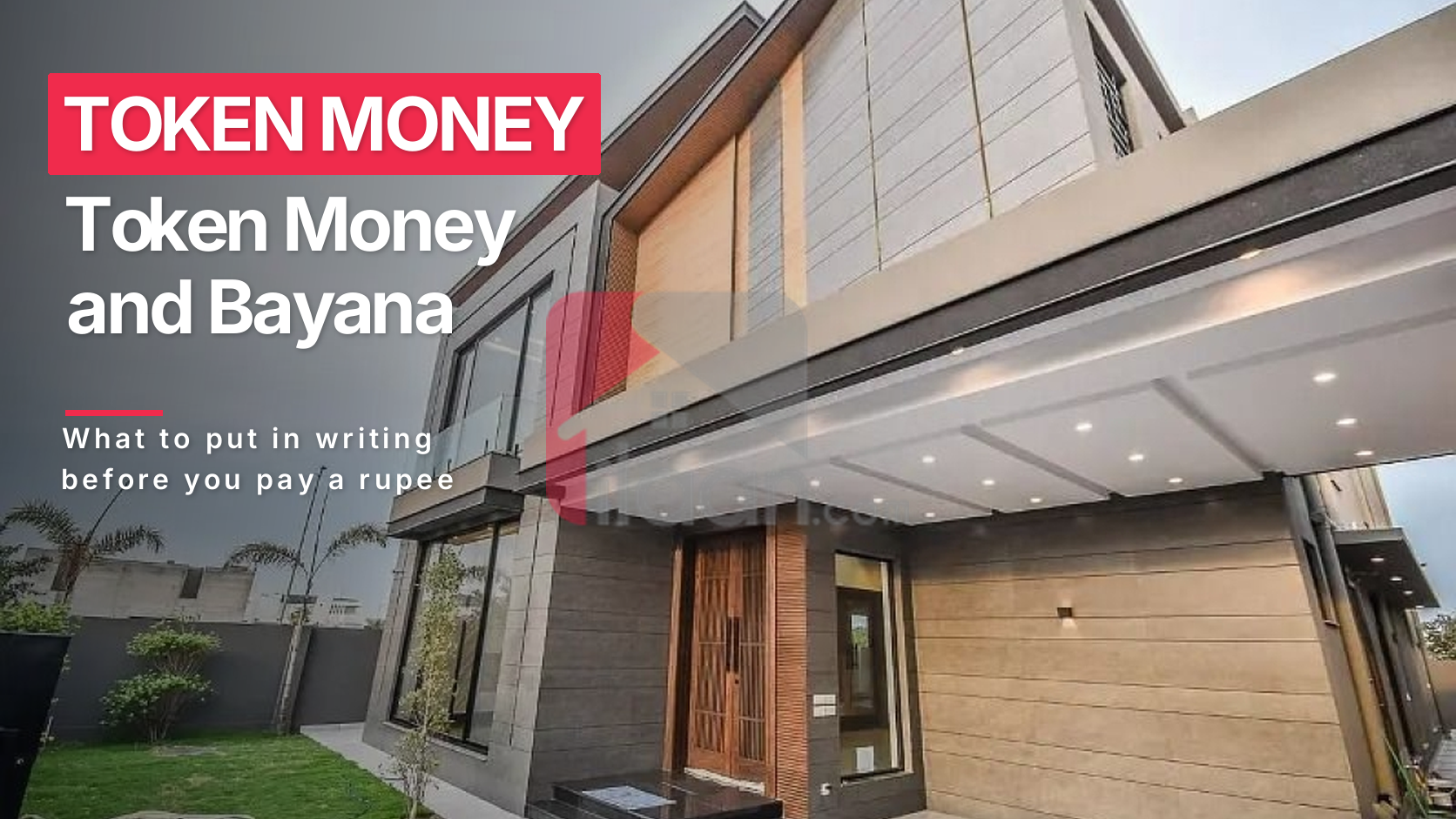
Most property disputes in Pakistan start before the registry office, when money changes hands on a verbal promise. A buyer pays a token, a seller stops showing the house, and then both sides discover they never agreed whether the token was refundable, how long the hold lasted, or what happens if either side walks away.
Token money and bayana are two different stages of a deal, not two names for the same payment.
Token money is a hold, not a purchase
Token money is a small amount relative to the price, paid after the price has been agreed in principle. It asks the seller to stop negotiating with other buyers for a short, fixed period, usually a few days, while the buyer checks papers, arranges funds, or confirms a family decision.
A token does not make you the owner, and it does not prove a full sale has been agreed. It buys time, and that time must have a clear end date.
Before you pay, settle five points in writing, even in a short signed receipt: the exact property, the agreed price, the amount and how it was paid, the date the bayana must be paid or the token ends, and whether the token is refundable and when. Without that last line, both sides will remember the conversation differently.
Pay in a way that leaves a trail: a bank transfer or pay order to the seller, with a receipt naming the property, amount, date, and recipient, is far easier to prove than cash with no record. If a dealer holds the token, the receipt should say so plainly.
Bayana is the deal in writing
Bayana, also called the agreement to sell or iqrar nama, follows a token. It is a written contract, commonly on stamp paper, signed by buyer and seller before witnesses. The buyer pays a substantial advance, and both sides commit to completing the sale on its terms.
There is no fixed bayana percentage in law. In practice it is often around 10 percent to 25 percent, but the figure is whatever both sides agree and record, with the amount paid, balance, and payment dates written down and signed.
A bayana agreement still does not make you the owner. Ownership passes only when the sale deed is signed and registered. The bayana is a signed promise to complete that sale, at an agreed price, by an agreed date.
Conditional token versus confirmed token
This distinction causes the most lost money, because the same word, token, is used for two very different arrangements.
A conditional token is tentative. The buyer likes the property but needs to confirm something first, such as family agreement, a loan decision, or a paper check. If the deal does not proceed, a conditional token is normally expected to be returned. That expectation only protects you if it is written on the receipt.
A confirmed token is firm. The buyer is saying that he is buying, that the seller should stop showing the property, and that the bayana will follow by a stated date. If the buyer then backs out, a confirmed token is generally treated as forfeitable, meaning the seller may keep it to compensate for the time the property was off the market. If the seller backs out, agreements commonly require double return, although enforcing that can be slow.
Never let the type of token stay verbal. Write the single word, conditional or confirmed, on the receipt, together with the refund rule and the bayana deadline.
What a proper bayana agreement must record
A proper bayana agreement does not need complicated language, but it needs complete facts: the people, the property, the money, the promises, and the consequences.
The people: full names, CNIC numbers, and addresses of buyer and seller, matching their identity documents.
The property: exact location, plot or house number, area, and boundaries, with the registry, fard, allotment letter, or society record that identifies it.
The money: total price, bayana already paid and how it was paid, balance remaining, and dates for each remaining payment.
The promises: a statement that the property is free from any loan, court case, or undisclosed claim, that all dues and charges up to transfer are the seller's, and whether possession will be handed over vacant, and on what date.
The consequences: what happens if either side fails to complete. Signatures of both parties and two witnesses complete it. Keep your original safe, with a copy kept separately.
The checks to finish before any token or bayana
No receipt can fix a property that was never the seller's to sell. Before a token, and certainly before a bayana, finish this short list.
Match the seller to the record: the name and CNIC on the title, allotment letter, or society record should match the person taking your money. If not, stop before paying.
Confirm the property record: the fard and sale deed chain for revenue land, the allotment letter and society record for a society property, including dues and transfer clearance, or the authority record for a DHA or development authority property.
Confirm possession and dues: whether the property is occupied, whether anyone has a claim to stay, and whether development, utility, or society charges are outstanding.
Confirm your total cost: transfer tax, stamp duty, registration fees, and society transfer charges depend on your filer status and the valuation figure for that property. Work those out before you commit.
If any check cannot be completed in the token period, extend the token in writing, with a new date and the same refund rule, or walk away.
Frequently asked questions
Is token money refundable in Pakistan?
It depends on the type and what was written. A conditional token is normally refundable, a confirmed token is generally forfeitable if the buyer backs out.
How much bayana is normally paid?
There is no fixed legal percentage. It is often around 10 percent to 25 percent, but the figure is whatever both sides agree and record.
Does a bayana agreement make me the owner of the property?
No. A bayana is an agreement to sell, a signed promise to complete the sale at an agreed price by an agreed date. Ownership passes only when the sale deed is signed and registered.
What should I check before paying a token?
Match the seller to the record, confirm title and society records, check possession and dues, and work out total cost. If a check cannot be finished in the token period, extend the token in writing or walk away.
The bottom line
Token money buys time. Bayana buys commitment. Neither buys ownership, and neither protects you if the terms stay verbal. Put the property, price, amount, deadline, and refund rule in writing before you pay, and verify seller and record before you sign.
If you are buying, browse verified direct owner listings on ilaan.com and deal at zero commission. Overseas or short on time: unlock owner contacts with Prime. When it is your turn to sell, get Gold Verified for a one time PKR 3,000: field verification, title check, 30 photos and video, and managed viewings.
This guide is general information, not legal advice. Procedures and charges vary by city, authority, and society.